

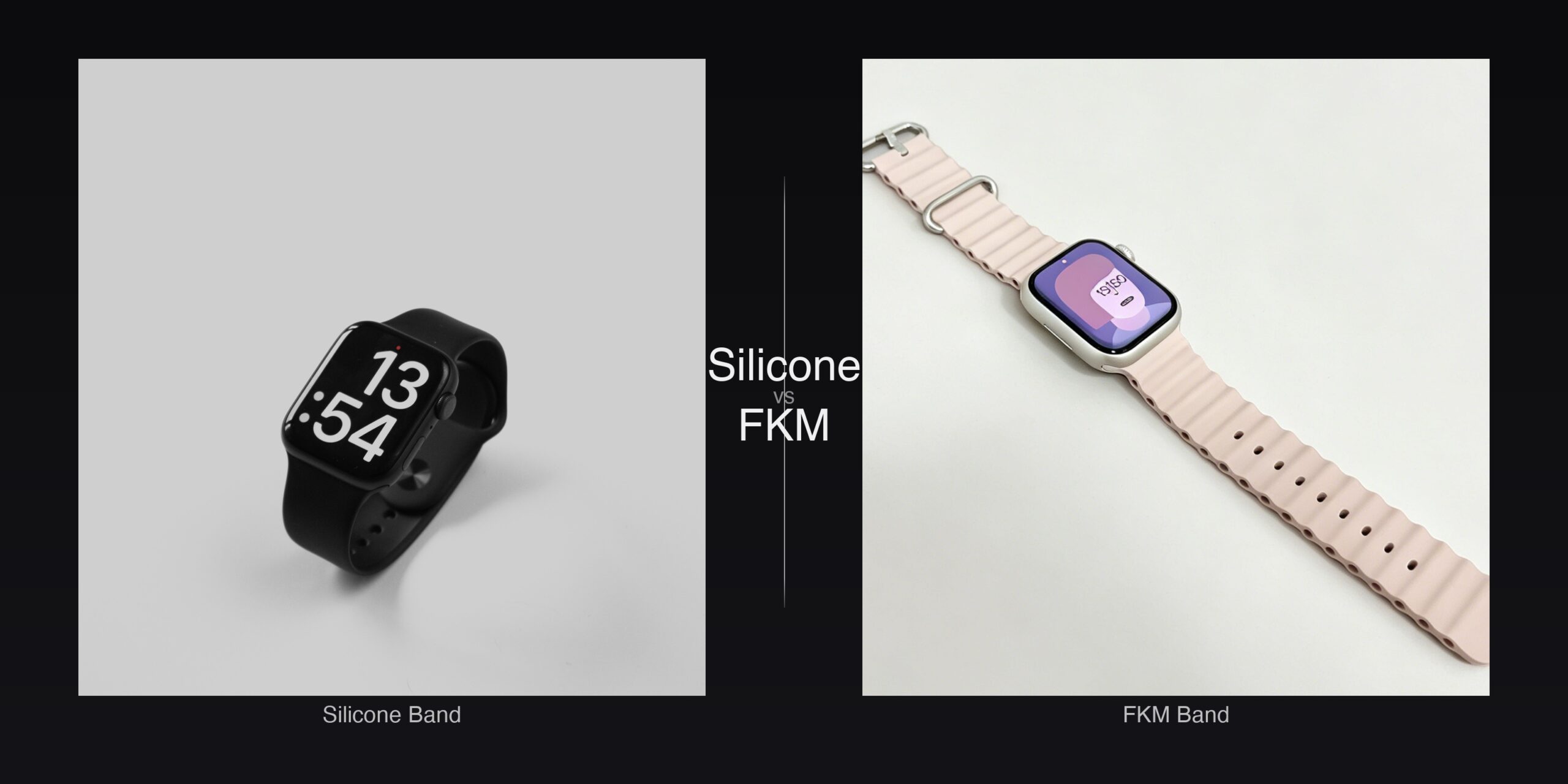
Choosing the right material for your Apple Watch bands is not just a product decision—it is a positioning decision. For brands, retailers, and online sellers, material choice directly affects pricing, target customers, perceived quality, and long-term product strategy.
Among the most common options in the market today, silicone and FKM (fluoroelastomer) stand out as two widely used materials for sport-style Apple Watch bands.
While they may look similar at first glance, their performance, cost structure, and market positioning are quite different.
In this guide, we break down the key differences between silicone and FKM Apple Watch bands to help you decide which material is better for your product line.
Key Takeaways
- Silicone is cost-effective and widely used for entry-level and mass-market products
- FKM offers better durability, a cleaner feel, and a more premium positioning
- Both materials are suitable for sport-style Apple Watch bands
- The right choice depends on your target market, pricing strategy, and brand positioning
- Many brands use both materials to cover different product tiers
What Is Silicone in Apple Watch Bands?
Silicone is one of the most commonly used materials in the watch strap industry. It is flexible, lightweight, and relatively easy to produce, making it ideal for high-volume, cost-sensitive products.
For Apple Watch bands, silicone is often used in:
- Entry-level product lines
- Fitness-oriented collections
- Promotional or large-volume projects
Advantages of Silicone
- Lower material and production cost
- Soft and flexible feel
- Lightweight and comfortable for daily wear
- Wide range of color options
- Easy to scale for bulk orders
Limitations of Silicone
- Can attract dust more easily
- Less resistant to heat and chemicals compared to FKM
- May feel less “premium” in higher-end markets
What Is FKM (Fluoroelastomer)?
FKM, also known as fluoroelastomer, is a higher-performance material commonly used in demanding environments such as automotive and industrial applications.
In Apple Watch bands, FKM is positioned as an upgraded alternative to standard silicone, offering better durability and a cleaner overall feel.
Advantages of FKM
- Higher resistance to heat, sweat, and chemicals
- More durable over long-term use
- Smoother, cleaner surface feel
- Better dust resistance
- More premium perception in the market
Limitations of FKM
- Higher material cost
- Typically higher MOQ for customization
- Slightly firmer feel compared to soft silicone
Silicone vs FKM: Key Differences
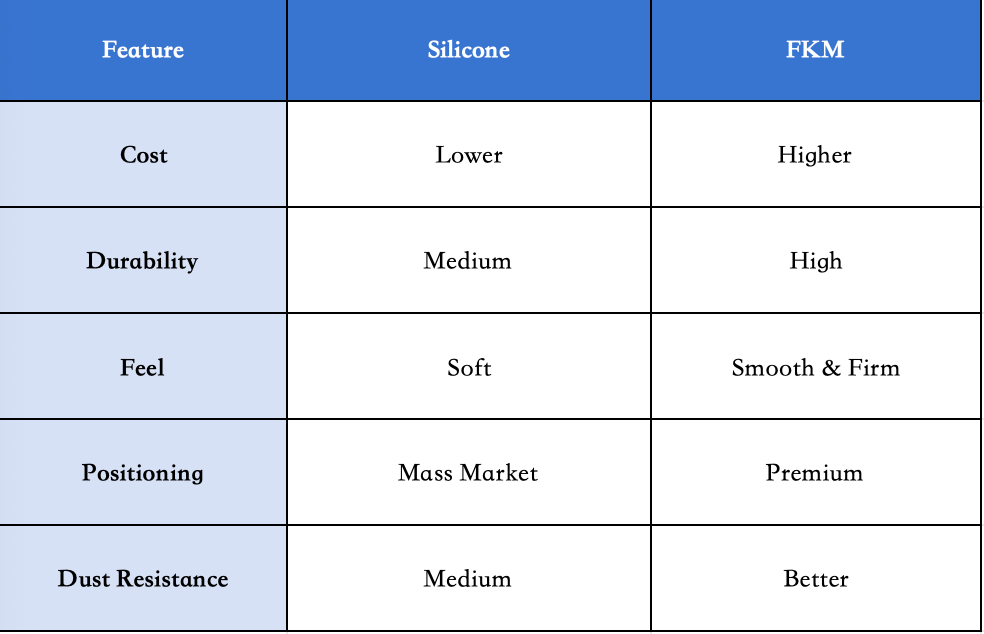
1. Material Performance
FKM performs better in demanding environments. It resists sweat, heat, and chemicals more effectively, making it more suitable for intensive use or long-term wear.
Silicone, while still practical, is better suited for everyday use rather than high-performance scenarios.
2. Comfort and Wearability
Both materials are comfortable, but they feel slightly different:
- Silicone: softer, more flexible
- FKM: smoother, slightly firmer, cleaner touch
For many users, the difference becomes more noticeable over extended wear.
3. Durability
FKM has a clear advantage in durability. It maintains its shape, color, and surface quality better over time.
Silicone may show wear faster, especially in high-friction or outdoor use environments.
4. Cost and Pricing Strategy
This is one of the most important factors for brands.
- Silicone → lower cost, ideal for entry-level pricing
- FKM → higher cost, suitable for mid-to-premium positioning
If your target market is price-sensitive, silicone is often the better starting point.
If your brand is positioned as higher quality, FKM provides a stronger value proposition.
5. Market Positioning
Material choice directly affects how your product is perceived.
- Silicone → mass market, accessible, functional
- FKM → premium sport, performance-driven, higher-end
This is especially important for Shopify brands and retailers trying to differentiate their product line.
Which Material Is Better for Your Market?
There is no universal “better” option. The right choice depends on your business model.
Choose Silicone If:
- You are targeting entry-level or mid-range customers
- You need lower MOQ and cost flexibility
- You are testing new products
- You want to build a wide color-based product line
- Your focus is volume and accessibility
Choose FKM If:
- You are targeting a more premium segment
- You want stronger durability and performance positioning
- Your brand emphasizes quality and material differentiation
- You are building a long-term product line with higher margins
- You want to stand out from basic silicone competitors
Many Brands Use Both
In practice, many successful brands use both materials:
- Silicone → entry-level / volume products
- FKM → premium upgrade line
This allows them to serve different customer segments while maintaining a consistent design language.
Practical Tip: Start Simple, Then Expand
For many small and growing brands, it is often more effective to:
- Start with a few proven silicone styles
- Validate market demand
- Introduce FKM as an upgraded option
This phased approach reduces risk while allowing you to expand your product range strategically.
Final Thoughts
Silicone and FKM Apple Watch bands are both widely used for a reason. They serve different purposes, different price points, and different customer expectations.
Choosing the right material is less about which one is better overall, and more about which one aligns with your product strategy and target market.
If you approach material selection with a clear understanding of your customers and positioning, you will be able to build a more balanced and competitive product line.
Looking for Apple Watch Band Options?
At Doryok, we offer Apple Watch bands in both silicone and FKM materials, along with a range of styles and customization options for brands, retailers, and online sellers.
Contact us to discuss your product direction or request suitable recommendations.